
BERTI GRAF GUIDE
Click-lock flooring: a step-by-step installation guide
13 May 2026
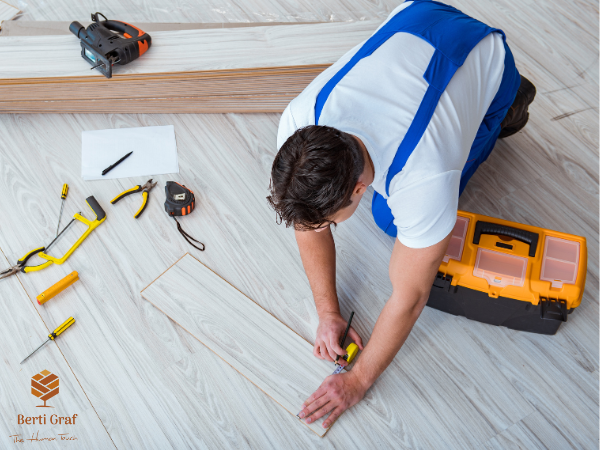
A click-lock system joins flooring panels using shaped locking profiles. In a floating installation, the panels are not bonded to the subfloor. The joining technique depends on the lock design, so read the chosen product’s instructions before starting.
1. Check the product and prepare the room
Check the design, quantity and condition of the panels. Follow the manufacturer’s storage conditions and any acclimatisation requirements. The often-mentioned 48-hour period is not a universal rule for every SPC panel.
2. Prepare the subfloor and underlay
The base should be clean, dry, stable and level within the product’s tolerances. Underlay is not a way to repair an uneven subfloor. Select moisture protection and underlay for the system. With factory-integrated underlay, do not add another layer unless the instructions expressly allow it.
3. Plan the first row and expansion gaps
Plan row widths and staggered joints. Leave the required gaps around walls, pipes and fixed fittings. The manufacturer specifies expansion gaps and any profiles between rooms; the 10 mm sometimes quoted is an example, not a rule for all systems.
4. Join panels using the correct technique
Use the joining method specified for the lock: angle-in, fold-down or another method described in the instructions. An angle of 30–45° is not suitable for every system. Do not strike panels with improvised tools. Check that edges are level and joints are closed: hearing a click alone does not prove a correct connection.
5. Finish and inspect the floor
Remove spacers and fit skirting boards and profiles while allowing the floor to move. Do not restrain a floating floor with fixings driven through the panels. Clean the surface and follow the product’s use and care instructions.
Why choose click-lock flooring?
It can simplify installation and reduce the need for adhesive. Whether individual planks can be removed or replaced depends on the lock type. Proper subfloor preparation and correct joints matter just as much as choosing the panel.